staff-team
-
The purpose of an Executive Pastor
This is probably the clearest I’ve got it so far, and I’ve been thinking about this for a while. The purpose of an Executive Pastor is to: Help the Team Leader ‘lead’. Support the Team as it ‘teams’. Keep gospel… Continue reading

-
Joke around, but don’t veil complaints in humour
One of our Staff Team Values is that we love joking around. We love laughing, jokes, sarcasm and generally hanging out together. That hasn’t happened by chance… it’s something we’ve worked hard to protect. But there’s a type of joking… Continue reading

-
Be careful giving feedback to people who don’t report to you
At one level, I think we all need to get better at giving specific, regular, behaviour based, feedback. But, we need to be careful that on doing so, we don’t undermine our peers, by encouraging their people to do things… Continue reading

-
How many staff should you have per person?
Israel had about 1 Levite per 11 other Israelites. But that’s not particularly helpful. This is a difficult question to answer because really… Who knows!?! The best you can do is have what you think is an appropriate ratio. But… Continue reading
-
How we arrived at the Purposes Model
After recently attending the very encouraging Nexus Conference I thought it’d be helpful to outline how we arrived at the Purposes Model. Back in 2008, we had 3 congregations and 1 more about to kick off. We had a Senior Pastor (Greg… Continue reading

-
Before you go to a “Purpose model” of church (like the Ms)… resign!
If there’s one aspect of the Purpose model of church structure that you really need to get, it’s that you need to resign as a single Congregation Pastor before you do it. I don’t mean resign in the sense that… Continue reading

-
The wonderful idea of using an “umbrella of mercy” when talking
I can’t remember where we got this idea but it’s brilliant… our staff team has this phrase “umbrella of mercy”. It’s what we say before we say something that could be taken the wrong way, or something that might be… Continue reading

-
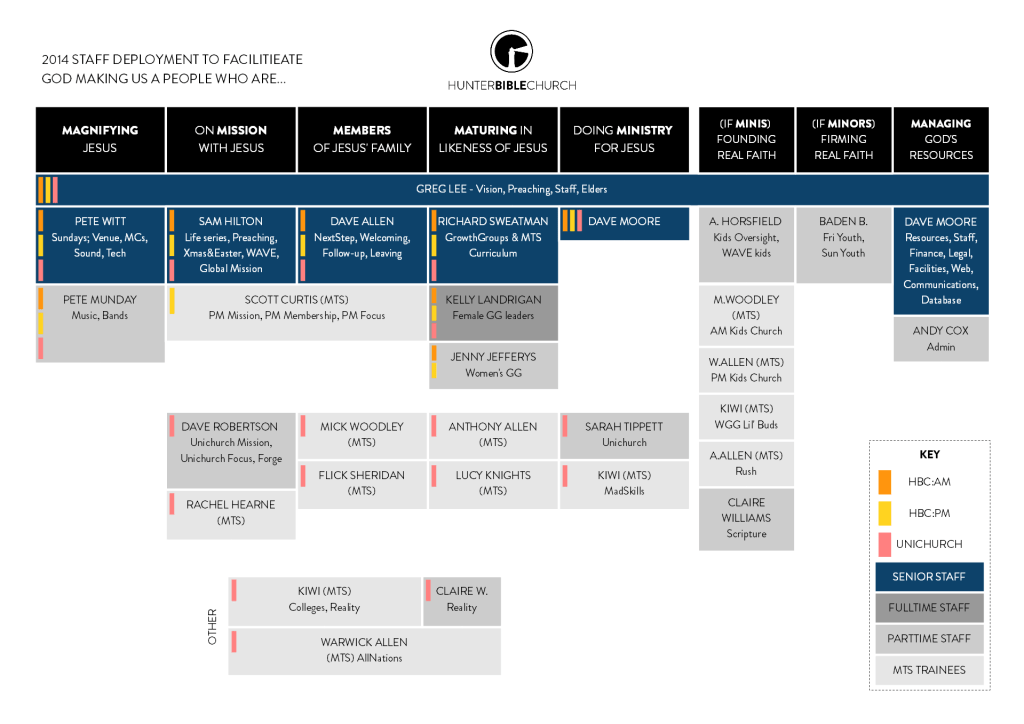
Church “Org charts” are hard
Recently we thought it would be a good idea to try and visually communicate our church staff “map”. It was an attempt to try and describe how we’ve deployed staff across our 5 passions for our flock, and across our… Continue reading
-
Reblog: Staff should fight and trust
A staff team is made up of different perspectives, strengths and weaknesses. A good team member will be aware of their own weaknesses, and the other’s strengths. And this will lead to good fighting based on strong trust. I will… Continue reading

-
Disagreement does not mean devaluing
It’s really important that we separate disagreeing from devaluing. Being disagreed with does not mean that we’re being devalued. Just because my boss doesn’t agree with me, that doesn’t mean he devalues me. Just because a husband decides against his wife’s… Continue reading

-
Why you should have purposes #6 : It’s not unbiblical! In fact…
Eph 4 was the kicker for me. Here’s how it goes: Jesus gives certain people to the church; [“Apostles, Prophets, Evangelists, Pastor-teachers”] (Leaders) These people are meant to “equip Jesus’ people for works of service” (Training, Mentoring, Encouraging) So, Jesus… Continue reading

-
Why you should staff “purposes” #1: Because you have a team of leaders
If you have a team of staff you should assign them purposes not congregations. In other words; staff “team” = Purpose based model is usually best. The reason for this is kinda simplistic, but it seems it needs to be… Continue reading

-
Externally solid, internally flexible
Great teams think highly of each other, trust each other, and are reluctant to jump on the bagging-out band-wagon when its aimed at their team mates. For example, even though I wasn’t the most liked guy on my rugby team… Continue reading
-
Beware divorcing rules from their reasons
Sometimes, setting rules is really helpful. Call them guidelines or self-imposed limits if you don’t like the idea of rules. But the fact is we do it all the time anyway. For example, we have a staff rule that male… Continue reading
-
Solve or manage? What type of tension are you dealing with?
There’s only two things you can do when you face a tension; a situation when you are faced with two good things and you can’t easily do both they way you’d like to. You can either solve the tension or… Continue reading
-
Turn feelings into numbers
Not every time, but sometimes, its really helpful to ask people to translate their feelings into numbers… just a simple scale of 1-10. It’s great because it avoids too-positive and too-negative assumptions. When someone says, “Yeah, I’m ok” what do… Continue reading
 MINISTRY PRINCIPLES & PRAGMATICS